How the Commercial Solar Tax Credit Works in 2026
The federal tax credit that homeowners leaned on ended in 2025. If you run a business in Riverview, Brandon, or anywhere across Hillsborough County, though, the commercial side of that credit is very much alive — and with Tampa Electric rates climbing year after year, 2026 is a genuinely good year to run the numbers on a commercial array.
The 30% credit hasn't gone anywhere
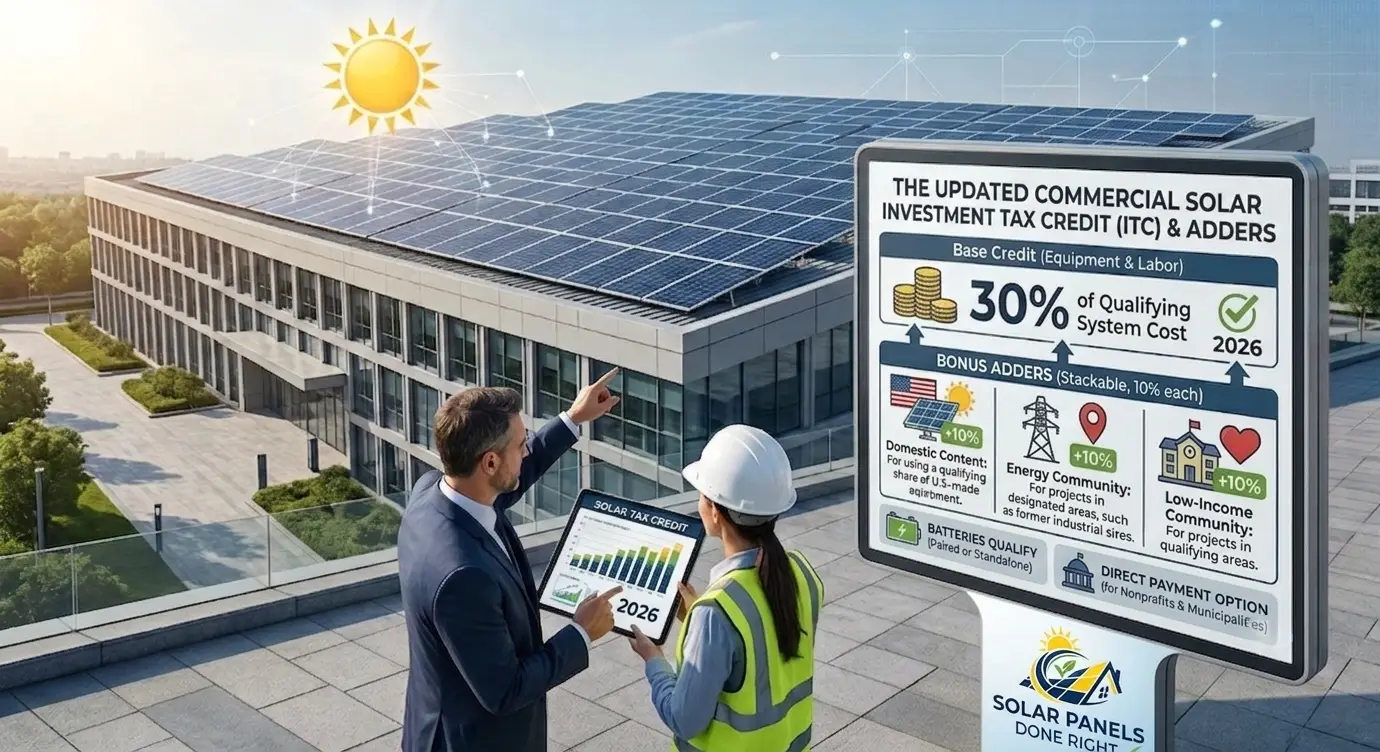
The commercial Investment Tax Credit (ITC) still covers 30% of a qualifying system's cost — panels, inverters, mounting, and the labor to install it. That's the floor, not the ceiling. Several bonus adders can stack on top, each worth roughly another 10% of the system cost:
- Domestic content — for using a qualifying share of U.S.-made equipment.
- Energy community — for projects on former industrial or fossil-fuel sites and similar designated areas.
- Low-income community — for projects in qualifying areas.
Hit one or more and the federal credit climbs well past 30%. Battery storage qualifies too, whether it's paired with panels or installed on its own, and tax-exempt operations like churches, nonprofits, and local governments can now take the credit as a direct cash payment instead of a tax offset.
The part people forget: depreciation
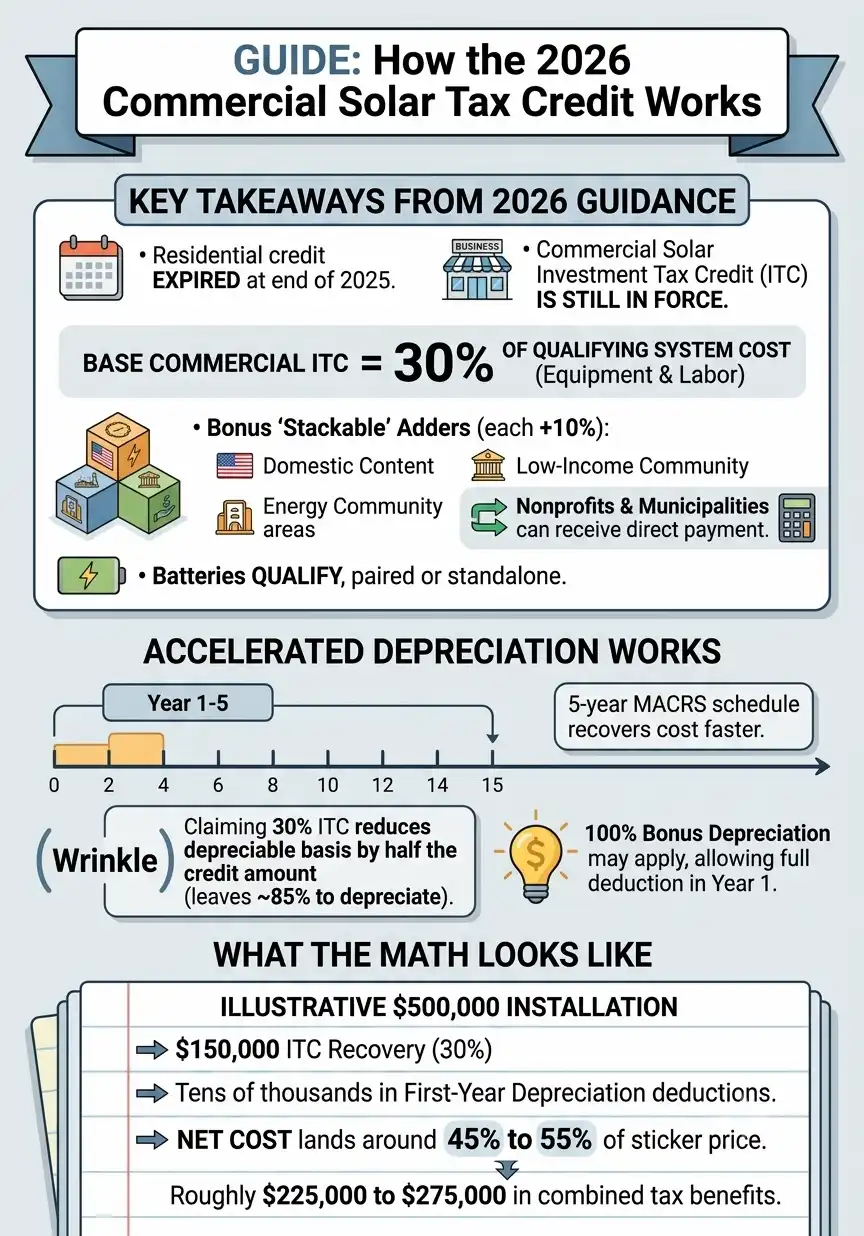
The credit is only half of what makes commercial solar work. The other half is accelerated depreciation. Solar is treated as five-year MACRS property, so its cost comes off your taxes over about six years on a front-loaded schedule. When you claim the 30% ITC, your depreciable basis drops by half the credit, leaving roughly 85% of the system cost to write off. And with 100% bonus depreciation, that entire amount can be deducted in the first year rather than spread out.
Putting real numbers on it
Take a $500,000 installation as a model:
- The 30% ITC returns about $150,000.
- First-year depreciation on the remaining basis adds tens of thousands more in deductions.
- After both, the net cost usually lands somewhere around 45% to 55% of the sticker price — roughly $225,000 to $275,000 in combined tax benefits on that example.
Your actual outcome depends on your company's tax position, so treat this as a model, not a promise, and confirm it with your accountant.
Two deadlines — and one is still open
Federal law gave commercial projects two separate ways to lock in the 30% credit: begin construction by July 4, 2026, or place the system in service by December 31, 2027. The first date has passed. The second is the one that matters now, and it's still wide open — meet it and the full credit, adders, and depreciation are all still on the table.
"Placed in service" is the detail that trips people up. It isn't the day you sign or the day equipment arrives — it's when the system is fully installed, inspected, and switched on, typically when Tampa Electric grants permission to operate and the array starts producing.
Why 2027 is closer than it looks
A commercial install is a chain of steps, and several depend on people outside your control:
- Engineering and structural review of the roof or ground site.
- Permitting through Hillsborough County.
- Equipment procurement, which carries real lead times.
- Interconnection with TECO, where the approval queue can stretch out for larger systems.
- Installation, final inspection, and permission to operate.
Each stage runs weeks to months, and they're partly sequential. Add them up and a comfortable path to a 2027 in-service date means starting in 2026 — not waiting until the deadline is in view.
Which businesses this fits
Commercial solar makes the most sense for operations with steady daytime power use and room for an array — roof, land, or parking. Around Hillsborough that's warehousing and distribution, manufacturing, retail centers, medical buildings, and offices. If your business has the tax appetite to use the credit and depreciation, the economics only get stronger.
How we run a commercial project
Solar is an electrical project first, and commercial work raises the stakes — interconnection, load, structural, and code all have to be right. Every job we take on is designed and installed in-house by our contractor, May Electric Solar, under licensed master-electrician oversight, and we manage the whole sequence: engineering, permitting, TECO interconnection, installation, and inspection. We'll model the after-tax return for your specific building and build the schedule backward from the deadline so you know exactly what has to happen and when.
The bottom line
A 30% federal credit, stackable adders, first-year depreciation, and rising TECO rates make 2026 a strong year for Hillsborough businesses to look hard at solar — and the window won't stay open forever. Request a free commercial assessment and we'll build the numbers around your property, or see our commercial solar page for how a project comes together.
This article is general information, not tax, accounting, or legal advice. Federal incentives, bonus adders, and deadlines are complex and subject to change, and depreciation depends on your business's situation. Consult a qualified tax professional before making decisions based on current incentives.